
Maruti Suzuki, Hyundai and Tata Motors reported their highest-ever dispatches to dealers last fiscal, enabling the domestic passenger vehicle industry to log in best-ever performance to date. The country's largest carmaker Maruti Suzuki India reported its highest wholesales to date at 19,66,164 units, up 19 per cent from 16,52,653 units in 2021-22. Its domestic dispatches rose to 17,06,831 units in 2022-23, up 21 per cent from 14,14,277 units in 2021-22 fiscal.Hyundai Motor India said its overall wholesales last fiscal were the highest ever since commencing operations in the country.

The Union government could target a fiscal deficit of 5.8-6 per cent of nominal GDP for 2023-24, and it should continue its capital expenditure push and look to simplify the personal income tax regime, economists recommended Finance Minister Nirmala Sitharaman and her team during their pre-Budget interaction on Monday. Starting last week, Sitharaman had eight pre-Budget consultations this time. More than 110 invitees representing seven stakeholder groups participated in these meetings, the finance ministry said in a statement. The stakeholder groups included representatives and experts from agriculture and agro-processing industry; industry, infrastructure & climate change; financial sector and capital markets; services and trade; social sector; trade unions and labour organisations; and economists.

Consumers can expect a 5G launch in the country soon. Telecom companies (telcos) say if auctions take place on time - the target is July - they would be able to offer some services in a few cities by the end of this year and a full roll-out from 2023. But the question is: will 5G turn the tables for telcos financially? Will average revenue per user (ARPU) improve? Will mobile consumers upgrade to 5G quickly and pay more? Will the expanded functions that 5G enables drum up sufficient revenues? In simple terms, will telcos make more money?

Politicians and Twitter warriors around the globe have a new buzzword among them: Net zero. Everyone appears to be keen to state their commitment to net zero, with India providing an outlay of Rs 35,000 crore to achieve energy transition and net-zero objectives in its Budget for FY24, even as the latest and final report by the United Nations' Intergovernmental Panel on Climate Change (IPCC) warned that current efforts are not enough to curb global warming. A number of small factory owners and businesses, however, have pointed out that the transition to net-zero emissions will cost them hugely.

The MG Motor India management is focused on scaling up and launching smaller cars to play the long game in the country, says Pavan Lall.

LIC's $2.7-billion initial public offering (IPO) shall be the fifth-biggest globally in CY22. South Korean EV battery maker LG Energy Solution holds the record for the year's largest IPO at $10.8 billion, while Chinese mobile communications provider China Mobile IPO, which raised $8.6 billion, comes second. Dubai Electricity and Water Authority's (DEWA's) $6.1-billion IPO in March is currently the third biggest public offering for the year, followed by China National Offshore Oil Corporation's (CNOOC's) IPO; the firm had raised $5.1 billion by issuing shares in Mainland China after delisting from the American bourses.

Increasing the duties on auto parts and putting an additional cess on petrol and diesel could drive up costs of vehicles, specially where volumes are low and localisation is not viable.

Why does the world's fastest-growing major consumer of energy fail to attract investments in oil and gas? This is a question worth pondering after private sector conglomerate Reliance Industries Ltd (RIL) failed to close a $15-billion downstream asset deal with Saudi Arabia's national oil company, Aramco. It's understandable if multi-billion dollar investments in oil and gas projects or deals involving state companies that need to traverse a complex bureaucracy at state and federal levels and the corridors of ministries unravel. However, Mukesh Ambani-run RIL, India's most successful energy company, is not typically known to fumble on closing deals (Ambani closed deals worth around Rs 2 trillion early last year in telecom and retail with blue chip investors).

Consumer stocks remain the biggest laggard on the bourses. The Nify50 weighting of FMCG stocks declined to a decade low of 9.9 per cent at the end of March this year, down 150 basis points from 11.4 per cent a year ago. At their peak in March 2013, major FMCG stocks, such as Hindustan Unilever, ITC, and Asian Paints, together accounted for 15 per cent of the Nifty50. But now together with automobile stocks, the consumer goods sector accounts for only 14.7 per cent of the index, down 200 basis points in the past 12 months and 37 per cent from the record high weighting of 23.4 per cent at the end of March 2014.

'We try to pick up stocks early and hold onto them for the long term.' 'We are not someone who buys and sells on a daily basis.'

Ratings agency ICRA on Wednesday revised downwards growth forecast for the domestic passenger vehicles industry to 8-11 per cent in the ongoing fiscal from the earlier estimate of 14-17 per cent on account of the ongoing semiconductor shortage. Similarly, for the two-wheeler segment, it said the volumes are expected to contract by 1-4 per cent in FY2022 against an earlier prediction of 6-8 per cent growth as affordability and demand sentiments of target clientele was hit sharply by the second wave of COVID-19 pandemic. With around 5 lakh units of production lost by various automakers in the passenger vehicles segment due to the semiconductor shortage, ICRA said the earnings loss for the OEMs (Original Equipment Manufacturers) could be around Rs 1,800 crore to Rs 2,000 crore for the ongoing fiscal.

Tamil Nadu Governor R N Ravi on Thursday staged an unprecedented walkout from the state assembly following a face-off with Chief Minister M K Stalin over the former's customary address to members of the house in its first session of the year.

MSI chairman R C Bhargava said auto sector would like to see GST benefits linked to greener/cleaner cars. The government gave tax cut on EVs but hybrid should be given duty cut. There should be tax cut on CNG vehicles.

MG Motor India is investing Rs 2,500 crore by the end of next year to increase the production capacity at its Halol plant in Gujarat, as it gears up to launch its mid-size SUV Astor, according to a top company official. Despite the worsening semiconductor shortage situation, which is likely to continue for at least another six months, the company expects its sales this year to grow by up to 100 per cent over last year. "We have done an investment of Rs 3,000 crore already, and by the end of next year, we will do another Rs 2,500 crore. "We will reach a total of Rs 5,500 crore," MG Motor India president and managing director Rajeev Chaba told PTI.

India's equity markets are on a roller-coaster ride, after delivering spectacular returns for two consecutive years - in 2020 and 2021. The benchmark National Stock Exchange's (NSE's) Nifty50 is down 1.5 per cent in the first nine months of the current calendar year 2022 (CY22) as foreign portfolio investors sold Indian stocks due to rising bond yields in the US and across global markets, including India. The sell-off in the Indian equity markets has, however, not been broad-based and largely limited to sectors facing earnings headwinds from rising interest rates, lower commodity and energy prices, and likely economic recession in advanced economies.

The company, which already has around 66 per cent market share in the hatchback segment and about 50 per cent in the overall domestic passenger vehicle segment, currently sells Vitara Brezza and S-Cross in the SUV segment. In an interaction with PTI, MSI managing director and CEO Kenichi Ayukawa acknowledged that there was some lag in launching new products due to the pandemic but the company is now on track regarding new model launches.

Initially it will procure only e-rickshaws and e-autos for leasing to operators

10 stocks which are most popular with brokerages right now and are expected to deliver maximum upside over the next 12 months.

Ola Electric is moving the delivery for the first batch of its electric scooters to between December 15 to the end of the month, a two- to four-week delay from its earlier schedule, due to a shortage of chipsets and electronic parts. The first batch of deliveries were scheduled for November 30 but the company decided to delay them after a meeting between its factory team and the global supply chain on Saturday. It became clear that the late delivery of chips and electronic parts was only 'getting worse', sources told Business Standard. Ola has apologised to customers for the delay and said it is "ramping up production as fast as we can so that you can get your Ola S1 at the earliest". It has stopped taking any new bookings until the chip shortage has eased, say sources.

SoftBank-backed Ola Electric took the wraps off its maiden e-scooter offerings -- Ola S1 and S1 Pro -- for a commercial launch on Sunday. With prices starting from Rs 99,999 (excluding state government incentives, registration fee, and insurance cost), the Bhavesh Aggarwal-founded firm said the e-scooters are designed and engineered in India for the world and will deliver the best scooter experience to the consumer. He suggested that after 2025, sale of petrol-powered two-wheelers should not be allowed.

'It is going to be extremely rapid and anybody who is not there, be it investor, manufacturer, supplier, will miss out.'

By industry estimates, less than five per cent of the passenger car market in India would comprise electric cars over the next five-seven years, at 1,75,000 units, when the industry size would double to 3.5 million units, as against over 1.6 million in 2009.

Automobile dealers' body FADA said the Budget lacked immediate demand boosters for the automobile industry.

Ajit Gandhi explains how healthy habits adopted during the pandemic can help us lead a healthier and environment. friendly lifestyle.
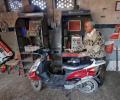
The new scheme may link the incentives to the battery power - higher the power, higher the incentive and most electric two-wheelers running on Indian roads use low power and fast charging batteries.

Weak consumer sentiment across urban and rural markets due to slow farm inflows, subdued agri-commodity prices, rising cost of ownership as a result of regulatory changes including safety, emissions, vehicle registration, along with a rise in interest cost/EMI, have impacted demand.

Modi has set a target of generating 100 Gw of solar power by 2022.

Experts say while the increasing demand for a ban on Chinese goods might make for good optics, the reality is that India is still heavily dependent on that country in a wide range of industries like electronics, mobile devices, auto, pharma, telecom equipment, and fertilisers.

Niranjan Upadhye, general manager, fraud risk management, Worldline India, tells you how to quickly spot a scam and save yourself from grief.

The much awaited Mahindra e20 launched on Tuesday.

While hybrids, CNG and biofuels found favour in 2018 among many carmakers including Maruti Suzuki, Mercedes-Benz, Toyota and Honda, others such as M&M and Tata Motors have shown full faith in electric vehicles.

The challenges of transition to stricter emission norm BS-VI from BS-IV and compliance to new safety norms thereby making vehicles costlier are lurking around the sector.
Vehicle sales across categories registered a decline of 8.62 per cent to 20,86,358 units from 22,83,262 units in May 2018.

Kia's Seltos SUV has already crossed the 40,000 mark while the slightly pricier MG Hector has sold nearly 13,000 units.

For deciding which vehicles are to be scrapped, the setting up of fitness centres and regulating them would be a humongous task.

US auto major Ford Motor Co on Friday said it and India's Mahindra & Mahindra have decided to scrap their previously announced automotive joint venture and it will continue its independent operations in India as it is. The two companies determined that they will not complete a previously announced automotive joint venture between their respective companies. The decision follows the passing of the December 31, 2020 'longstop' or expiration date of a definitive agreement the organisations entered into in October 2019, Ford Motor Company said in a statement.

While Muthuraman is suspected to be a Bharatiya Janata Party worker, Francis is believed to be a Communist Party of India activist, police said.

Farmers and opposition parties in Tamil Nadu on Monday staged rail roko agitation at various places in the state demanding the Centre to constitute the Cauvery Management Board immediately.

A rich blend of technology and earthy materials giving the Lexus NX 300h a unique look.
Investment bankers handling the IPO had said marquee global investors made big-ticket applications.
